


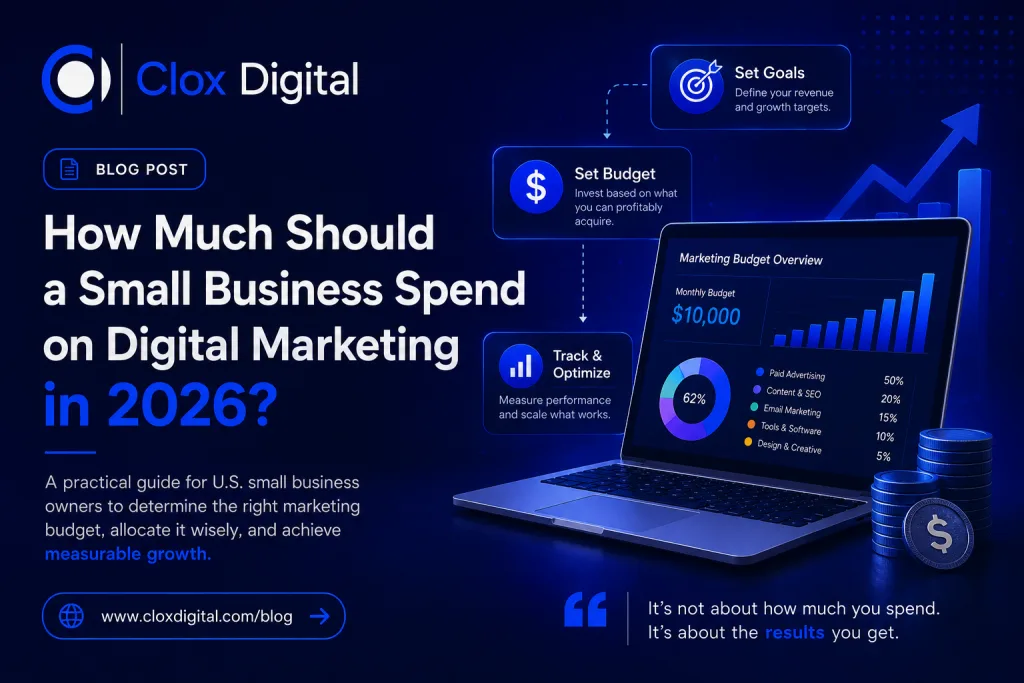
There is no magic number—but there is a smart way to determine what your business should invest.
One of the most common questions small business owners ask when considering digital marketing is:
“How much should I actually spend on marketing?”
Spend too little, and your business may struggle to generate enough visibility, leads, and sales.
Spend too much without a strategy, and you can burn through thousands of dollars without knowing whether your marketing is actually producing a return.
For U.S. small businesses in 2026, the better question isn’t simply “What percentage of my revenue should I spend?”
It is:
“How much can I invest in acquiring customers profitably, and which channels can produce the strongest return?”
That distinction can completely change the way you approach your marketing budget.
Marketing Is Becoming a Bigger Priority for Small Businesses
Despite economic uncertainty and rising operating costs, many small businesses are continuing to invest in marketing.
A February 2026 Constant Contact survey of more than 1,500 small business owners across several markets found that 68% expected to increase their marketing spend in 2026. The emphasis wasn’t simply on spending more—it was on getting more value from the money and time being invested. (Constant Contact)
Similarly, Clutch’s 2026 marketing budget research found that 60% of small businesses planned to increase their marketing budgets, with digital advertising and content marketing among the areas receiving increased attention. (Clutch)
The message is clear:
Businesses are not necessarily looking to spend more for the sake of spending more. They’re looking for marketing that can justify its cost.
So, How Much Should You Spend?
There isn’t a universal percentage that works for every business.
A company generating $100,000 per year cannot approach marketing the same way as a company generating $2 million.
Likewise, an established law firm, an e-commerce brand, a local restaurant, and a SaaS company can have completely different customer acquisition economics.
That is why we recommend thinking about your marketing budget according to business stage, customer value, growth objectives, and profitability.
As a broad planning framework, a small business might begin by considering a marketing budget in the range of 5%–10% of annual revenue, then adjust based on its industry, margins, growth stage, and customer acquisition economics.
This isn’t a rule or industry requirement.
It is a starting point for planning.
For businesses aggressively pursuing growth, a higher percentage may make sense. For established businesses relying heavily on referrals and repeat customers, a lower percentage may be sufficient.
The important thing is to understand what the money is expected to accomplish.
Don’t Confuse Your Marketing Budget With Your Ad Budget
This is one of the most important distinctions business owners should understand.
If you decide to invest $5,000 per month in marketing, that doesn’t necessarily mean you should put the entire $5,000 into Facebook or Google Ads.
Your marketing budget may need to cover:
- Paid advertising
- Website development
- Landing pages
- SEO
- Content creation
- Graphic design
- Video production
- Email marketing
- Marketing software
- CRM systems
- Analytics
- Agency or consultant fees
- Testing and optimization
Your advertising budget is only one component of the larger marketing investment.
This distinction becomes particularly important when evaluating agencies.
An agency fee and an advertising budget are not necessarily the same thing.
For example:
$3,000 advertising budget
$1,000 marketing management
does not mean the business has $4,000 available for advertising.
It means $3,000 is being used to purchase media while $1,000 pays for the strategy, management, optimization, creative, or other agreed services.
Understanding this from the beginning helps prevent unrealistic expectations.
Start With Your Revenue Goal
Instead of choosing a marketing budget because another business spends the same amount, start with what you’re trying to achieve.
Imagine you own a professional services company.
Your goal is to generate an additional:
$100,000 in annual revenue.
Your average customer is worth:
$5,000.
You therefore need approximately:
20 additional customers.
Now the marketing question becomes much more useful:
What can we reasonably afford to spend to acquire each customer?
If your business can profitably acquire a customer for $500, your theoretical acquisition budget for 20 customers is:
20 × $500 = $10,000
That is far more strategic than simply saying:
“Let’s spend $10,000 on Facebook.”
You’re starting with the business objective and working backward.
Understand Your Customer Acquisition Cost
One of the most important numbers in digital marketing is Customer Acquisition Cost (CAC).
CAC tells you approximately how much your business spends to acquire one customer.
The basic formula is:
CAC = Total Marketing & Sales Acquisition Costs ÷ Number of New Customers
For example:
You spend $6,000 on marketing and sales activities.
You acquire 20 new customers.
Your CAC is:
$6,000 ÷ 20 = $300
Now you can ask a much more important question:
Is acquiring a customer for $300 profitable?
That depends on the value and margin of the customer.
Don’t Look at Revenue Alone—Look at Customer Value
Suppose your business sells a $500 service.
At first glance, spending $300 to acquire that customer might seem reasonable.
But what if your gross profit is only $150?
Your acquisition strategy would be losing money.
Now imagine that the same customer typically purchases additional services and generates $2,500 in revenue over three years.
Suddenly, spending $300 to acquire that customer may make considerably more sense.
This is why businesses need to understand Customer Lifetime Value (LTV) rather than evaluating every customer based solely on their first transaction.
A good marketing strategy should consider:
How much does the customer spend?
How often do they buy?
How long do they remain a customer?
How much profit does the relationship generate?
Where Should Your Marketing Budget Go?
This is where many small businesses make mistakes.
They try to be everywhere.
Google.
Facebook.
Instagram.
TikTok.
YouTube.
LinkedIn.
Email.
SEO.
Influencers.
Podcasts.
And more.
The result?
A little money everywhere and insufficient investment anywhere.
A better approach is to identify where your customers are most likely to discover, evaluate, and purchase from your business.
For example:
Local service business
A local service company might prioritize:
Google Search + Local SEO + Reviews + Retargeting
because customers may already be searching for the service.
E-commerce business
An online retailer might prioritize:
Meta Ads + Google Shopping + Email + Retargeting
because discovery and repeat purchases can both contribute significantly to growth.
B2B company
A B2B company might focus on:
SEO + LinkedIn + Content + Email + Sales Outreach
depending on its target market.
Professional services
A law firm, accounting firm, consulting company, or agency may benefit from:
Google Search + SEO + Educational Content + Reviews + Retargeting
because trust and high-intent searches can be extremely important.
Your marketing budget should follow your customer’s journey—not marketing trends.
Paid Advertising Deserves Careful Planning
Paid advertising can produce results quickly, but it can also consume a budget quickly.
This is why you shouldn’t begin with:
“How much should I spend on Facebook?”
Start with:
“How much can I afford to pay to acquire a customer?”
Then work backward.
Suppose:
- Average customer value: $2,000
- Gross profit per customer: $1,000
- Target acquisition cost: $250
- Desired customers: 20
Your target acquisition budget would be:
20 × $250 = $5,000
Now your advertising campaign has an economic framework.
You can evaluate whether the campaign is moving toward that goal rather than judging it by likes, impressions, or clicks alone.
Don’t Scale a Campaign Just Because It Gets Attention
A campaign can generate:
100,000 impressions
5,000 clicks
500 leads
and still be a bad campaign if those leads don’t become profitable customers.
On the other hand, a campaign generating fewer clicks may produce significantly more revenue.
This is why metrics such as these matter:
- Cost per lead
- Qualified lead rate
- Customer acquisition cost
- Conversion rate
- Customer lifetime value
- Revenue generated
- Return on ad spend
- Overall return on marketing investment
The objective isn’t to make your dashboard look impressive.
The objective is to make your business more profitable.
What About Businesses That Are Just Starting?
A new business has a different challenge.
You may not have historical data.
You don’t yet know:
- Which audience converts best
- Which offer performs best
- Which advertising platform works best
- What your CAC will be
- Which messages resonate with customers
That means your initial marketing budget should include room for testing.
Don’t expect your first campaign to immediately become your perfect campaign.
Your first campaigns should help answer questions.
Which audience responds?
Which offer generates interest?
Which creative produces qualified leads?
Which landing page converts?
Which customers are actually profitable?
Once you have those answers, you can allocate more money toward what works.
The Importance of a Testing Budget
Let’s say a business has $5,000 available for a new digital marketing initiative.
Instead of immediately spending all $5,000 behind one advertisement, the business could allocate part of its budget to testing:
Audience A
Audience B
Creative A
Creative B
Offer A
Offer B
Landing Page A
Landing Page B
The purpose isn’t to create unnecessary complexity.
It’s to avoid making a major financial commitment based on an assumption.
Once the data begins showing what works, the business can move more of its budget toward the strongest combination.
Don’t Forget About the Website
There’s another reason businesses sometimes waste marketing money:
They invest heavily in generating traffic before fixing their website.
Imagine spending $4,000 on advertising only to send visitors to a website that:
- Loads slowly
- Looks outdated
- Doesn’t clearly explain the offer
- Has no strong CTA
- Doesn’t establish trust
- Is difficult to use on mobile
- Has a complicated contact form
Your advertising may actually be doing its job.
The website is simply failing to convert the attention you’re paying for.
This is why your marketing budget should consider the entire customer journey.
Traffic → Website → Trust → Offer → Conversion → Follow-up → Sale
Every stage matters.
How Much Should You Spend If You Have $1,000, $5,000 or $10,000?
There isn’t one correct allocation, but here’s an example framework.
If you have $1,000/month
Focus on one primary acquisition channel.
Don’t attempt to dominate every platform.
Prioritize:
- One advertising channel
- Strong landing page
- Basic tracking
- Conversion optimization
- Retargeting where practical
Your objective should primarily be learning what works.
If you have $5,000/month
You have more room to build a system.
You could consider:
- Paid advertising
- Landing page optimization
- Content/creative
- Retargeting
- Email follow-up
- SEO or organic content
At this level, measurement becomes increasingly important.
If you have $10,000+/month
You can begin testing multiple acquisition channels and investing more heavily in optimization.
For example:
Primary acquisition
→ Google or Meta
Secondary acquisition
→ SEO/content
Conversion
→ Landing pages
Retention
→ Email/CRM
Optimization
→ Analytics and testing
The objective becomes building a repeatable acquisition system rather than simply running individual campaigns.
When Should You Increase Your Marketing Budget?
Don’t increase your budget simply because you have more money available.
Increase it when you have evidence that additional investment can produce additional profitable growth.
For example:
Your campaign spends $5,000.
It generates 25 customers.
Your CAC is $200.
The customers are profitable.
Your conversion system can handle more leads.
Your sales team has capacity.
That may be a good reason to increase spending.
But if you spend $5,000 and cannot determine where your customers came from, increasing the budget may simply increase your losses.
Scale what works.
Don’t scale uncertainty.
The 2026 Marketing Budget Mindset
The most successful small businesses won’t necessarily be the ones with the biggest marketing budgets.
They’ll be the ones that understand how to allocate, measure, and optimize the budget they have.
Current industry research reinforces this shift toward measurable, digital and performance-oriented investment. Clutch reports that 46% of surveyed marketers expect more than half of their marketing budgets to go toward digital channels, while 34% identify proving direct impact on revenue or measurable outcomes as a major challenge. (Clutch)
Even larger organizations are facing the same pressure. Gartner’s 2026 research found that awareness and conversion together account for 62.6% of total media spend, reflecting a continued emphasis on acquisition and measurable growth. (Gartner)
For a small business, that lesson is particularly important.
You don’t have to outspend your competitors.
You need to understand your numbers better than they do.
A Simple Formula for Building Your Marketing Budget
If you’re unsure where to start, use this framework:
Step 1: Determine your revenue goal
How much additional revenue do you want?
Step 2: Determine your customer value
How much revenue and profit does an average customer generate?
Step 3: Determine your acquisition target
How much can you reasonably afford to spend acquiring one customer?
Step 4: Determine how many customers you need
Revenue goal ÷ average customer value
Step 5: Build your acquisition budget
Number of desired customers × target CAC
Step 6: Add your marketing infrastructure
Consider:
Website, landing pages, creative, software, CRM, email, SEO, agency/consulting and other necessary costs.
Step 7: Measure and optimize
Then continuously ask:
What’s generating customers?
What’s wasting money?
What should we scale?
What should we stop?
The Bottom Line
There is no magic marketing budget that every U.S. small business should follow.
A $1,000 monthly budget may be enough to test a focused strategy for one business and completely inadequate for another.
A $10,000 budget can generate tremendous growth for one company and become an expensive lesson for another.
The difference is strategy.
Your marketing budget should be connected to your business goals, customer economics, acquisition costs, conversion rates, and ability to deliver the product or service you’re selling.
Don’t ask:
“How much should I spend on marketing?”
Ask:
“How much can I profitably invest to acquire and retain a customer—and how can I scale that process?”
That is the question that turns marketing from an expense into a growth strategy.
At Clox Digital, we believe marketing should be accountable to business results—not vanity metrics.
We don’t sell. We solve.
Clox Digital — Digital Marketing, Strategy, Web Development and Growth Solutions for businesses ready to turn digital visibility into measurable results.
