
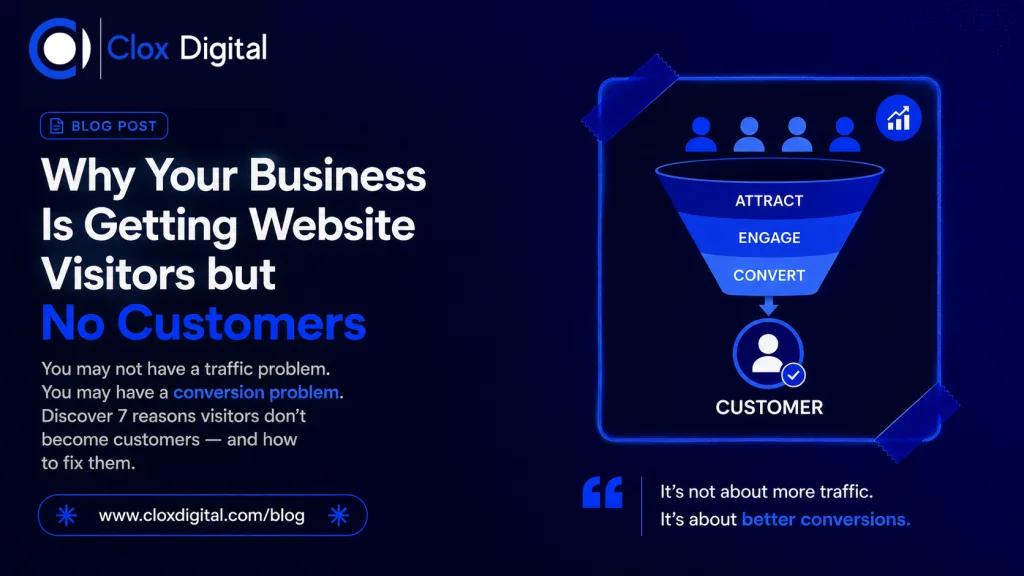
Your website may not have a traffic problem. It may have a conversion problem.
For many small business owners in the United States, getting people to visit a website feels like the hardest part of digital marketing.
So they invest in Google Ads. They post consistently on social media. They publish blog articles. They run promotions. They improve their SEO.
Then they look at their analytics and see something encouraging:
People are visiting the website.
But the phone isn’t ringing.
The contact form isn’t filling up.
Nobody is booking a consultation.
And sales aren’t increasing.
If this sounds familiar, the problem may not be that your marketing isn’t working. The problem may be what happens after someone arrives on your website.
A successful digital marketing strategy doesn’t end when someone clicks your ad or visits your website. The real objective is to turn that attention into action—and ultimately into revenue.
Here are seven reasons your website may be getting visitors but failing to generate customers.
1. Visitors Don’t Immediately Understand What You Do
You have only a short amount of time to communicate your value.
A visitor should be able to answer three questions almost immediately:
What do you offer?
Who is it for?
Why should I choose you?
Unfortunately, many small business websites make visitors work too hard to find these answers.
The homepage may say:
“Transforming Ideas Into Possibilities”
or:
“Your Partner for a Better Tomorrow.”
These statements may sound professional, but they don’t necessarily tell a potential customer what the business actually does.
Compare that with:
“Commercial HVAC Repair & Maintenance for Businesses Across Dallas.”
The second message immediately establishes the service, target customer, and location.
Your website shouldn’t make customers figure out your business.
Your value proposition should be clear enough that someone who has never heard of your company can understand what you do within seconds.
2. You’re Getting Traffic, But You’re Attracting the Wrong People
More website traffic isn’t always better.
Imagine a law firm receives 10,000 visitors in a month but only 20 are actually looking for the services it provides.
Meanwhile, another firm receives 1,000 visitors and 100 of them become qualified leads.
Which business has the better marketing?
The second one.
This is why traffic should never be your only marketing objective.
Your business needs the right traffic.
For example, a local plumbing company in Phoenix doesn’t necessarily need thousands of visitors from New York, London, or Los Angeles.
It needs people in its service area who actually need plumbing services.
Similarly, an accounting firm specializing in small businesses doesn’t necessarily need millions of social media views. It needs business owners who are actively looking for accounting help.
The goal isn’t to attract everyone.
The goal is to attract the people most likely to buy.
This is why audience targeting, search intent, keyword strategy, geographic targeting, and accurate messaging matter so much.
3. Your Website Doesn’t Give People a Reason to Take Action
A visitor can understand your business perfectly and still leave without contacting you.
Why?
Because you haven’t given them a compelling reason to act.
Consider two websites.
The first says:
“Contact us for more information.”
The second says:
“Book Your Free 30-Minute Business Consultation.”
The second provides a much clearer next step.
Your website should guide visitors toward an action.
Depending on your business, that action could be:
- Request a quote
- Book a consultation
- Schedule an appointment
- Purchase a product
- Start a free trial
- Call your business
- Download a guide
- Request a demo
- Submit an inquiry
This is where calls to action (CTAs) become important.
Don’t assume visitors will automatically know what to do next.
Tell them.
4. Your Website Doesn’t Build Enough Trust
A customer isn’t simply asking:
“Can this company provide this service?”
They’re also asking:
“Can I trust this company with my money?”
This is especially important for small businesses competing against established companies.
A visitor may be interested in your service but hesitate because they don’t know enough about you.
Your website should answer the concerns that exist in the customer’s mind.
Strong trust signals can include:
- Customer testimonials
- Reviews
- Case studies
- Client results
- Industry certifications
- Guarantees where appropriate
- Professional photography
- Clear contact information
- Transparent service information
- Business credentials
- Secure payment options
- Relevant experience
For example, saying:
“We provide digital marketing services.”
is very different from:
“We’ve helped businesses generate qualified leads through targeted search and social advertising.”
The second communicates experience and a specific outcome.
Your website should not only explain what you do.
It should demonstrate why customers should believe you.
5. Your Offer Isn’t Strong Enough
Sometimes the problem isn’t the website.
It’s the offer.
You can have excellent design, great advertising, and thousands of visitors—but if the offer doesn’t feel valuable, people won’t act.
Ask yourself:
Why should someone buy from me today instead of waiting?
Your offer doesn’t necessarily need to involve a discount.
It could be:
- A free consultation
- A free assessment
- A complimentary quote
- A free strategy session
- A bundled service
- Faster delivery
- A guarantee
- A useful resource
- A limited onboarding opportunity
For example, compare:
“Contact our agency today.”
with:
“Book a free 30-minute marketing audit and discover the three biggest opportunities currently limiting your lead generation.”
The second gives the visitor a tangible reason to continue.
6. You’re Sending Paid Advertising to the Wrong Page
This is one of the most expensive mistakes a small business can make.
A company spends $2,000 on advertising.
The advertisement promotes:
“Get a Free Roof Inspection.”
But clicking the advertisement takes the visitor to a generic homepage containing:
- About Us
- Our Services
- Blog
- Careers
- Contact
- Multiple unrelated services
The customer now has to search for the offer they were interested in.
That’s friction.
Instead, the advertisement should ideally lead to a dedicated landing page designed around the specific campaign.
For example:
Advertisement
Free Roof Inspection for Homeowners in Austin
↓
Landing Page
Free Roof Inspection for Austin Homeowners
↓
Proof
Customer reviews + previous projects
↓
Offer
Free inspection
↓
CTA
Schedule Your Inspection
The closer the message and experience are between the advertisement and the landing page, the easier it is for the visitor to continue toward conversion.
7. You’re Not Following Up With People Who Didn’t Buy
This is one of the biggest opportunities small businesses overlook.
Not everyone who visits your website is ready to buy immediately.
Someone might discover your business today and need your service three weeks from now.
Another person might request information but not respond immediately.
Someone else might add a product to their cart and leave.
That doesn’t necessarily mean they aren’t interested.
It means the timing wasn’t right.
This is where follow-up becomes critical.
Depending on your business, you can use:
- Email marketing
- SMS where appropriate
- Retargeting advertising
- CRM systems
- Automated follow-up sequences
- Educational content
- Personalized sales follow-ups
Instead of treating every non-conversion as a lost customer, create a system for continuing the conversation.
The first visit doesn’t always produce the sale.
Sometimes the follow-up does.
The Bigger Problem: You’re Measuring the Wrong Thing
One of the biggest mistakes business owners make is celebrating traffic without measuring what happens afterward.
You might hear:
“Our website received 25,000 visitors this month!”
That’s interesting.
But the more important questions are:
How many leads did those visitors generate?
How many qualified leads did you receive?
How many became customers?
How much revenue did those customers generate?
This is where digital marketing becomes a business discipline rather than simply a visibility exercise.
Consider this example:
Business A
50,000 website visitors
500 leads
20 customers
$20,000 revenue
Business B
5,000 website visitors
300 leads
75 customers
$90,000 revenue
Business B receives only 10% of Business A’s traffic.
Yet it generates significantly more revenue.
Traffic isn’t the finish line.
Conversion is.
A Simple Way to Diagnose Your Website
Before spending more money on advertising, walk through your own website as if you’ve never seen it before.
Ask yourself:
1. Can I immediately understand what this company does?
If not, fix your messaging.
2. Do I understand who this service is for?
If not, clarify your target customer.
3. Do I understand why I should choose this company?
If not, strengthen your positioning and proof.
4. Is there a clear next step?
If not, improve your CTA.
5. Can I easily find evidence that this company is trustworthy?
If not, add reviews, testimonials, case studies, credentials, and other relevant proof.
6. Is the website easy to use on a phone?
A significant portion of your audience will interact with your business through mobile devices, so the mobile experience cannot be treated as an afterthought.
7. What happens if I don’t buy today?
If the answer is “nothing,” you may be losing potential customers who simply weren’t ready yet.
Your Website Should Work With Your Marketing—Not Against It
Digital marketing works best when every part of the customer journey supports the next.
Think about the process this way:
Advertisement / Search / Social Media
↓
Website or Landing Page
↓
Trust + Value Proposition
↓
Offer
↓
Call to Action
↓
Lead
↓
Follow-Up
↓
Customer
↓
Repeat Customer
If one part of that journey is broken, your entire marketing system can suffer.
You could have excellent advertisements but a poor landing page.
You could have a great website but no traffic.
You could generate hundreds of leads but have poor follow-up.
You could acquire customers but fail to retain them.
Digital marketing isn’t one activity. It’s a system.
Before You Spend More on Marketing, Fix Your Conversion Strategy
If your website is receiving visitors but generating very few customers, your first instinct shouldn’t necessarily be to increase your advertising budget.
Sometimes the smarter move is to improve what happens after the click.
Improve the message.
Improve the offer.
Improve the landing page.
Improve your trust signals.
Improve your calls to action.
Improve your follow-up.
Improve your measurement.
Then, once the system is converting more effectively, you can scale the traffic going into it.
Because sending more people to a website that doesn’t convert doesn’t solve the problem.
It simply creates more expensive visitors.
The Bottom Line
Your website doesn’t need to be the most beautiful website on the internet.
It needs to be clear, credible, persuasive, and easy to act on.
The goal of digital marketing isn’t simply to make your business visible.
It’s to make your business visible to the right people, give them a reason to trust you, and make it easy for them to become customers.
If your business is generating traffic but not enough sales, don’t immediately assume you need more traffic.
You may need a better customer journey.
At Clox Digital, we believe effective digital marketing should connect visibility to measurable business growth.
We don’t sell. We solve.
Clox Digital
Digital Marketing | Strategy | Web Development | Growth
Helping businesses build stronger digital systems that attract customers, generate leads, and drive sustainable growth.