
A customer is only valuable when the cost of acquiring them makes business sense.
Many small business owners know how much they charge for a product or service.
Far fewer know exactly how much it costs to acquire a paying customer.
That difference can have a major impact on profitability.
A business can generate hundreds of leads, thousands of website visitors, and substantial social media engagement while still struggling financially if acquiring those customers costs too much.
On the other hand, a business with a relatively high marketing budget can be extremely profitable if it has a strong customer acquisition system and knows how to turn marketing investment into long-term customer value.
This is why one of the most important numbers a U.S. small business owner should understand is Customer Acquisition Cost, or CAC.
What Is Customer Acquisition Cost?
Customer Acquisition Cost is the average amount a business spends to acquire one new customer.
At its simplest:
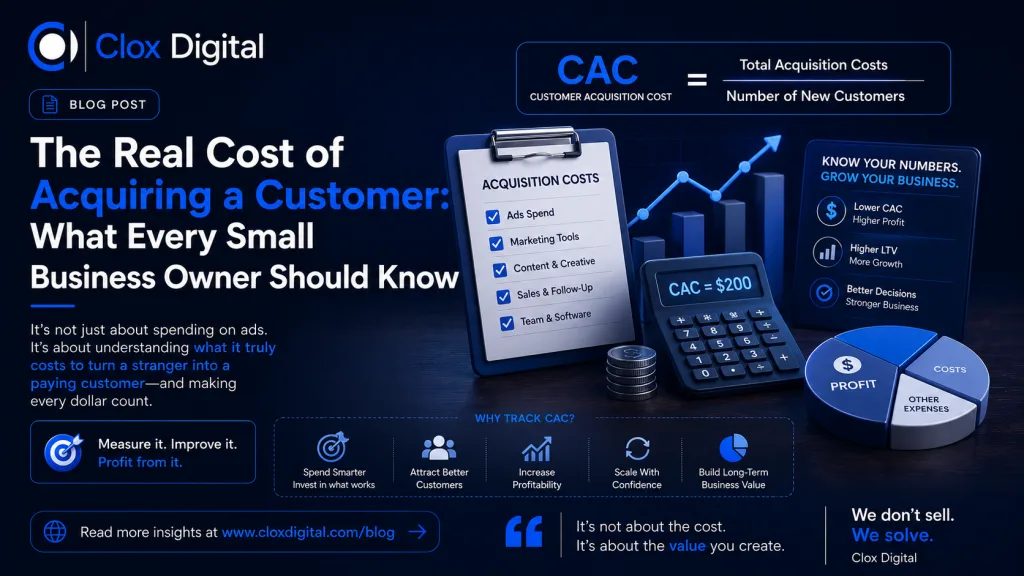
CAC = Total Customer Acquisition Costs ÷ Number of New Customers
For example, imagine a business spends:
- $3,000 on advertising
- $1,000 on marketing services
- $500 on creative production
- $500 on sales and acquisition software
The total acquisition investment is:
$5,000
If those activities generate 25 new customers:
$5,000 ÷ 25 = $200 CAC
The business is effectively spending $200 to acquire each customer.
But that number alone doesn’t tell you whether the marketing is profitable.
You need to compare it with what those customers are actually worth.
A $200 Customer Acquisition Cost Isn’t Automatically Bad
This is where many business owners make a mistake.
They see a $200 CAC and immediately think:
“That’s too expensive.”
But expensive compared to what?
Suppose your business sells a $100 product.
A $200 CAC would obviously create a serious problem if customers only purchase once.
But imagine you’re a consulting firm where the average client generates $8,000 in revenue over the relationship.
A $200 CAC could be extremely attractive.
The question isn’t:
“How much does it cost to acquire a customer?”
The better question is:
“How much profit can this customer generate compared with what it costs to acquire them?”
Revenue Isn’t the Same as Profit
Consider a simple example.
A customer purchases a product for:
$1,000
Your business spends:
$300 to acquire the customer.
At first glance, that looks like a $700 difference.
But the business may also have:
- Product costs
- Shipping
- Payment processing
- Employee costs
- Software expenses
- Returns
- Customer support
- Operational overhead
If the actual gross profit from the transaction is only $350, the economics are very different.
This is why CAC should be evaluated alongside profit margins, not simply revenue.
A marketing campaign can generate impressive sales while still producing disappointing profits.
Customer Lifetime Value Changes the Equation
Some businesses make most of their money from the first purchase.
Others make money over months or years.
This is where Customer Lifetime Value (LTV) becomes important.
LTV represents the economic value a customer generates over their relationship with your business.
Imagine a customer purchases:
$500 initially
Then returns four more times and spends:
$1,500
Their total revenue is:
$2,000
If your profit margins are healthy, acquiring that customer for $200 may be very reasonable.
Now imagine another customer buys once for $100 and never returns.
A $200 acquisition cost would be much harder to justify.
This creates an important principle:
Don’t evaluate customer acquisition only by the first transaction.
Look at the relationship.
The Difference Between a Lead and a Customer
This is particularly important for businesses running lead-generation campaigns.
Suppose you spend:
$2,000
and generate:
100 leads.
Your cost per lead is:
$20.
That sounds excellent.
But what happens next?
If only five leads become customers:
$2,000 ÷ 5 = $400 CAC
Your actual customer acquisition cost is $400—not $20.
This is why celebrating low cost-per-lead numbers without examining lead quality can be misleading.
A business should care about qualified leads and customers, not simply cheap leads.
Your Marketing Funnel Determines Your CAC
Customer acquisition doesn’t happen at one point.
It happens across a journey.
Consider:
Advertisement
↓
Click
↓
Website
↓
Lead
↓
Qualified Lead
↓
Sales Conversation
↓
Customer
↓
Repeat Customer
Every stage affects your eventual acquisition cost.
For example, you might have an inexpensive advertising campaign that generates plenty of leads.
But if the website converts poorly, your CAC increases.
Or perhaps your website generates excellent leads but your sales team takes three days to respond.
Your conversion rate may fall.
The result?
Higher CAC.
This is why customer acquisition should be viewed as a system, not simply an advertising expense.
Your Ad Isn’t the Only Thing Affecting Customer Acquisition Cost
A common misconception is:
“My Facebook Ads are too expensive.”
Maybe.
But maybe not.
Your CAC can be affected by:
- Audience targeting
- Advertising platform
- Creative quality
- Offer
- Landing page
- Website
- Pricing
- Sales process
- Lead qualification
- Follow-up
- Customer retention
- Product quality
- Brand reputation
Imagine two businesses both spend $5,000 on advertising.
Business A
5,000 clicks
300 leads
30 customers
CAC:
$166.67
Business B
5,000 clicks
300 leads
10 customers
CAC:
$500
They spent exactly the same amount.
They generated the same number of clicks.
They generated the same number of leads.
Yet Business A acquired customers for roughly one-third the cost.
The difference may be everything that happened after the click.
The Hidden Cost of Poor Follow-Up
Here’s a scenario that happens frequently.
A potential customer submits a form requesting information.
The business receives the notification.
Nobody responds for six hours.
Then someone sends a generic email.
The customer doesn’t reply.
The business marks the lead as “not interested.”
But perhaps the customer simply contacted three competitors and chose the one that responded first.
Your advertising generated the lead.
Your business paid for the lead.
But your sales process lost the opportunity.
This is why CAC isn’t purely a marketing metric.
It is a business metric.
Marketing, sales, customer service, technology, and operations can all influence it.
The Most Important Question: What Can You Afford to Pay for a Customer?
There is no universal “good CAC.”
A reasonable acquisition cost for one business could destroy another.
Instead, determine your own economics.
Start with:
Average Customer Revenue
How much does the average customer spend?
Then determine:
Gross Profit
How much remains after the direct costs of delivering your product or service?
Then consider:
Customer Lifetime Value
How much additional business does the customer typically generate?
Finally ask:
Target CAC
How much can you reasonably invest to acquire that customer while maintaining healthy margins?
This gives your marketing team something far more useful than an arbitrary advertising budget.
Example: A Local Service Business
Imagine a home remodeling company.
Average project:
$15,000
Average gross margin:
30%
Gross profit:
$4,500
If the company can consistently acquire a customer for $750, the acquisition economics may be attractive.
But suppose the company is spending $3,000 to acquire each customer.
The marketing strategy needs to be examined.
Perhaps:
- The ads are targeting the wrong homeowners.
- The website isn’t converting.
- The leads aren’t qualified.
- The sales team isn’t following up.
- The offer isn’t compelling.
- The company is competing on price.
The answer isn’t automatically:
“Stop advertising.”
The answer may be:
“Find out why customer acquisition is so expensive.”
Example: An E-Commerce Business
Now consider an online store.
Average order value:
$120
Gross profit per order:
$60
If customers typically purchase only once, spending $70 to acquire a customer would create an immediate problem.
But suppose the company has a strong retention strategy.
The average customer makes five purchases over two years.
Suddenly, that initial customer acquisition investment can make considerably more sense.
This is why e-commerce companies often pay close attention to:
- Repeat purchases
- Email marketing
- Retargeting
- Customer loyalty
- Upselling
- Cross-selling
- Subscription models
Acquiring the customer is only the beginning.
The Cheapest Customer Isn’t Always the Best Customer
Another important point:
Low CAC does not automatically mean high-quality customers.
Suppose Campaign A generates customers for $100.
Campaign B generates customers for $250.
It might appear obvious that Campaign A is better.
But what if:
Campaign A
Average customer value: $200
Campaign B
Average customer value: $2,000
Campaign B could be dramatically more valuable despite its higher CAC.
This is why businesses need to evaluate customer acquisition based on economics and quality, not simply cost.
Why Cheap Leads Can Be Expensive
Imagine you run a campaign offering a free consultation.
You generate:
500 leads at $5 each.
That’s only:
$2,500
Sounds fantastic.
But if most of those leads have no intention of buying, your sales team may waste hours trying to convert them.
Meanwhile, another campaign might generate:
100 leads at $20 each.
That’s also:
$2,000
But those leads may be significantly more qualified.
If 20 become customers from the second campaign compared with five from the first, the “more expensive” leads were actually cheaper in terms of customer acquisition.
Optimize for customers—not cheap leads.
How to Lower Your Customer Acquisition Cost
There are several ways to improve CAC without simply reducing your advertising budget.
1. Improve Your Targeting
Get more specific about who you want to reach.
Instead of targeting everyone who could theoretically use your service, identify the customers most likely to purchase.
2. Improve Your Offer
A strong offer can increase conversion without requiring additional traffic.
Give potential customers a compelling reason to take the next step.
3. Improve Your Creative
Your advertisement needs to communicate the problem, value, and outcome clearly.
Better creative can improve the efficiency of your existing traffic.
4. Improve Your Landing Page
Make it immediately clear:
What you’re offering
Who it’s for
Why you’re credible
What the customer should do next
5. Improve Your Follow-Up
Respond quickly.
Use appropriate email, phone, SMS, or CRM workflows.
Don’t assume that one unanswered message means the lead is lost.
6. Improve Your Sales Process
If marketing generates qualified leads but sales cannot convert them, your CAC will remain high.
Review:
- Response time
- Sales scripts
- Objection handling
- Qualification
- Follow-up frequency
- Closing process
7. Increase Customer Lifetime Value
Sometimes lowering CAC isn’t the only solution.
You can improve the economics by making existing customers more valuable.
Consider:
- Repeat purchases
- Subscriptions
- Retainers
- Upsells
- Cross-sells
- Loyalty programs
- Referrals
If customers generate more profit over time, you may be able to invest more confidently in acquiring them.
Referrals Can Change Your CAC
Not every customer needs to come from paid advertising.
Existing customers can become an acquisition channel themselves.
A satisfied customer may refer:
Customer → Friend → New Customer
The cost of acquiring that new customer can be dramatically lower than acquiring someone through paid advertising.
This is why customer experience is part of marketing.
Your customers aren’t simply the end of your funnel.
They can become part of your acquisition strategy.
Don’t Compare Your CAC to Another Company’s CAC
Business owners sometimes ask:
“What is the average CAC for my industry?”
Industry benchmarks can provide context, but they shouldn’t become your primary decision-making tool.
Your business has its own:
- Pricing
- Margins
- Customer value
- Geography
- Sales cycle
- Competition
- Product
- Brand
- Conversion rate
A CAC that works for a national software company may make no sense for a local restaurant.
A CAC that works for a $10,000 consulting engagement may be completely inappropriate for a $100 product.
Your numbers matter more than someone else’s benchmark.
CAC Should Be Tracked by Channel
Don’t only calculate one overall CAC.
Where possible, compare acquisition performance across channels.
For example:
| Channel | Spend | Customers | CAC |
|---|---|---|---|
| Google Ads | $4,000 | 20 | $200 |
| Meta Ads | $4,000 | 10 | $400 |
| Organic Search | $2,000 | 25 | $80 |
| $500 | 15 | $33 |
This immediately gives you a better understanding of where your acquisition investment is producing results.
But remember that these numbers should be interpreted carefully.
Organic search, for example, may require months of investment before producing significant results, while paid advertising can generate traffic immediately.
Don’t evaluate channels solely by short-term CAC.
Consider the entire economic picture.
The Goal Isn’t Always to Have the Lowest CAC
This is perhaps the most important lesson in this article.
The goal is not:
Lowest possible customer acquisition cost.
The goal is:
Profitable customer acquisition at a sustainable scale.
If you can acquire a highly valuable customer for $500, there may be no reason to obsess over reducing the cost to $400 if doing so would reduce customer quality or limit growth.
Sometimes spending more to acquire the right customer is the smarter business decision.
When Should You Increase Your Marketing Budget?
Once you understand your acquisition economics, scaling becomes easier.
Suppose your business knows that:
Target CAC = $250
Your campaigns consistently achieve:
$200 CAC
Customers are profitable.
Your sales team has capacity.
Your fulfillment operation can handle additional demand.
You may have a strong case for increasing your marketing investment.
But if your CAC is:
$600
and your customers generate only:
$400 in gross profit,
increasing your advertising budget is unlikely to solve the problem.
First fix the economics.
Then scale.
The CAC Dashboard Every Small Business Should Watch
You don’t need a complicated analytics department to start.
Track these numbers consistently:
Marketing Spend
How much are you investing?
Leads
How many inquiries are you generating?
Qualified Leads
How many are actually potential customers?
Customers
How many become paying customers?
CAC
How much does each new customer cost?
Average Customer Value
How much revenue does an average customer generate?
Gross Margin
How much profit remains after direct costs?
Customer Lifetime Value
How valuable is the customer over time?
Return on Marketing Investment
What financial return is your marketing generating?
Once these numbers are visible, marketing decisions become considerably more strategic.
Your Marketing Budget Should Follow Your Customer Economics
This brings us back to a point we discussed in our previous article:
How much should a small business spend on digital marketing?
The answer becomes much easier when you understand CAC.
Instead of saying:
“We can afford $5,000 per month.”
you can say:
“We can profitably acquire customers for approximately $300 each, and we want to acquire 30 additional customers this quarter.”
That’s a strategy.
Your marketing budget now has a purpose.
The Real Cost of Not Knowing Your CAC
The biggest danger isn’t necessarily having a high CAC.
It’s not knowing what your CAC is.
Without that information, you may:
- Scale an unprofitable campaign
- Stop a profitable campaign
- Chase cheap leads
- Overspend on the wrong audience
- Underinvest in a valuable channel
- Misjudge your marketing agency
- Misunderstand your sales performance
- Make decisions based on likes and clicks instead of revenue
You can’t optimize what you don’t measure.
The Bottom Line
Every customer has an acquisition cost.
The question is whether your business understands that cost well enough to make profitable decisions.
Don’t simply ask:
“How much did we spend on advertising?”
Ask:
“How many customers did that investment generate?”
Then go further:
“How profitable are those customers?”
And further still:
“How much more could those customers be worth over time?”
That is how marketing becomes a measurable business function rather than a monthly expense.
The businesses that understand their customer acquisition economics can make smarter decisions about advertising, sales, retention, and growth.
You don’t need the cheapest acquisition strategy.
You need an acquisition strategy that makes financial sense—and can scale.
At Clox Digital, we help businesses connect digital marketing with the numbers that matter: qualified leads, customer acquisition, conversions, and sustainable growth.
We don’t sell. We solve.