
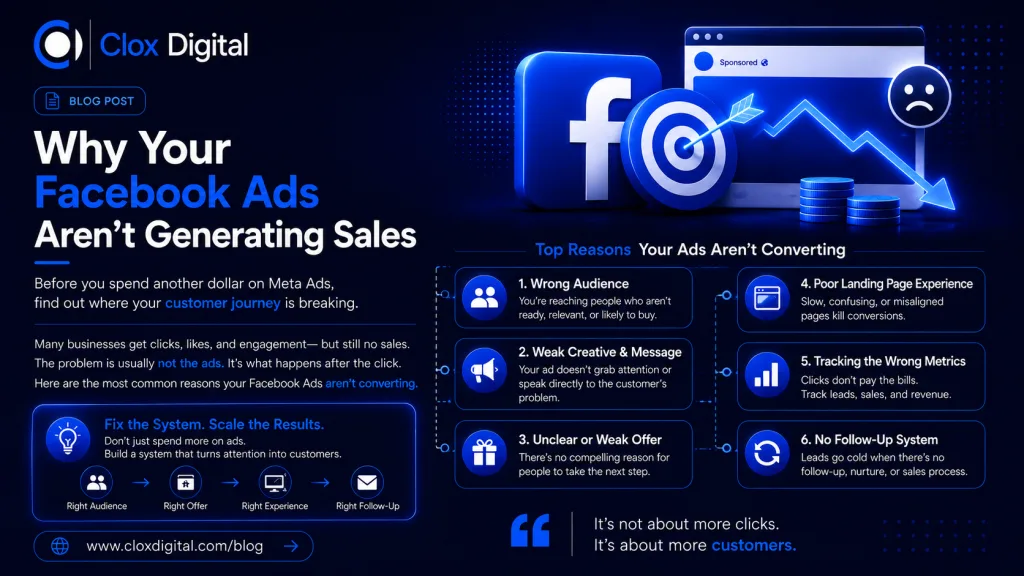
Before you spend another dollar on Meta Ads, find out where your customer journey is breaking.
You launched the campaign.
The ads are getting impressions.
People are clicking.
Some are even engaging with your content.
But sales?
Almost nothing.
For many U.S. small business owners, this is the point where frustration sets in. The conclusion is often:
“Facebook Ads don’t work for my business.”
But that conclusion is usually too early.
Meta advertising can be a powerful customer acquisition channel, but an advertisement is only one part of the sales process. A campaign can generate attention and clicks while still failing to produce profitable customers.
In fact, the problem may not be your Facebook ad at all.
It could be your audience, offer, creative, landing page, tracking, sales process, or follow-up.
Meta itself emphasizes evaluating campaigns based on the broader outcome rather than isolated engagement metrics. For example, Meta’s recent Audience Network guidance notes that higher click volume can sometimes coincide with lower conversion rates per click, making it important to evaluate total conversions and post-impression signals rather than relying on clicks alone. (Facebook)
So before increasing your budget, let’s identify where things may be going wrong.
1. You’re Optimizing for the Wrong Result
This is one of the biggest mistakes businesses make.
You want sales.
But your campaign is optimized for:
Traffic.
Or:
Engagement.
Or:
Video views.
The platform can deliver exactly what you ask it to deliver.
If you optimize for clicks, you may get clicks.
If you optimize for engagement, you may get engagement.
But neither automatically guarantees customers.
Your marketing objective should match your business objective.
If your goal is:
E-commerce sales
you need a campaign structure designed around purchases.
If your goal is:
Lead generation
you need to optimize around qualified leads.
If your goal is:
Appointments
your campaign and conversion system should be built around bookings.
The metric you optimize for influences the behavior you’re asking the platform to find.
2. Your Ad Is Reaching People Who Aren’t Ready to Buy
Having a large audience doesn’t mean having the right audience.
Imagine you’re a high-end personal injury law firm.
Your advertisement reaches 100,000 people.
That sounds impressive.
But how many of those people:
- Are in your service area?
- Need your type of legal service?
- Have the problem you’re solving?
- Can afford your service?
- Are actively looking for help?
- Are likely to contact you?
Those questions matter more than the size of your audience.
The objective isn’t to reach everyone.
It’s to reach people who have a reason to act.
This is why customer research should come before campaign creation.
You need to understand:
Who is the customer?
What problem are they experiencing?
What are they trying to achieve?
What objections stop them from buying?
Why would they choose you?
The better you understand those questions, the easier it becomes to create advertising that resonates.
3. Your Creative Doesn’t Give People a Reason to Stop Scrolling
Your potential customer is seeing countless pieces of content every day.
Your advertisement has to compete for attention.
A weak advertisement might say:
“We provide quality marketing services for businesses.”
There’s nothing necessarily wrong with the statement.
But it doesn’t create much curiosity.
Now consider:
“You’re getting website visitors but almost no customers. Here’s what might be costing you sales.”
The second message identifies a specific problem.
That is much more likely to make the right business owner think:
“That’s exactly what I’m dealing with.”
Your advertising should connect with a problem, desire, question, or opportunity that already exists in your customer’s mind.
4. You’re Selling the Service Instead of Selling the Outcome
Customers rarely wake up wanting to purchase a marketing service.
They want:
More customers.
A business owner may not want:
“Meta advertising management.”
They may want:
“A consistent flow of qualified leads.”
A homeowner may not want:
“HVAC maintenance.”
They want:
“A reliable air conditioning system that doesn’t break down in the middle of summer.”
A law firm client may not want:
“Legal representation.”
They want:
“Someone who can help them navigate their legal problem.”
Your advertisement should connect your service to the outcome the customer actually cares about.
5. Your Offer Isn’t Compelling Enough
Even when someone is interested in your business, they still need a reason to take the next step.
Your advertisement might say:
“Contact us today.”
But why?
What happens when they contact you?
What are they getting?
Why should they act now?
A stronger offer could be:
“Book a free 30-minute marketing assessment and discover the three biggest opportunities currently limiting your lead generation.”
Now there is a clear value exchange.
Depending on your business, your offer could involve:
- Free consultations
- Free assessments
- Quotes
- Demonstrations
- Trials
- Samples
- First-time customer incentives
- Educational resources
- Product bundles
The offer should be relevant to the customer and commercially sustainable for the business.
6. Your Landing Page Is Killing Your Campaign
Here’s a common scenario.
Someone sees:
“Get a Free Business Marketing Audit.”
They click.
Instead of seeing a page about the marketing audit, they arrive on a generic homepage.
There’s:
About Us
Services
Blog
Portfolio
Contact
Careers
and several unrelated offers.
The customer now has to figure out what to do.
That’s friction.
A better journey would be:
Advertisement
Get Your Free Marketing Audit
↓
Landing Page
Find Out What’s Preventing Your Business From Generating More Leads
↓
Proof
Testimonials / results / credentials
↓
Offer
Free audit
↓
CTA
Book My Audit
The ad creates the expectation.
The landing page fulfills it.
The CTA completes the next step.
7. Your Website Isn’t Converting the Traffic You’re Paying For
Sometimes your advertisement is doing its job.
People click.
But then they leave.
Why?
Your website could be:
- Too slow
- Difficult to navigate
- Poorly designed
- Confusing
- Missing trust signals
- Unclear about pricing
- Missing a strong CTA
- Difficult to use on mobile
- Asking for too much information
Remember:
Your advertisement gets the visitor through the door.
Your website has to convince them to stay.
If your website converts poorly, increasing your advertising budget can simply increase the amount of money you’re spending to send people to a broken customer journey.
8. You’re Measuring Clicks Instead of Customers
This is perhaps the biggest mindset shift a business owner can make.
Imagine your campaign produces:
50,000 impressions
2,000 clicks
150 leads
That might look impressive.
But what if only five people become customers?
Now imagine another campaign produces:
15,000 impressions
600 clicks
60 leads
20 customers
Which campaign would you rather have?
The second one.
That’s why businesses need to look beyond surface-level metrics.
Pay attention to:
- Cost per lead
- Qualified leads
- Lead-to-customer rate
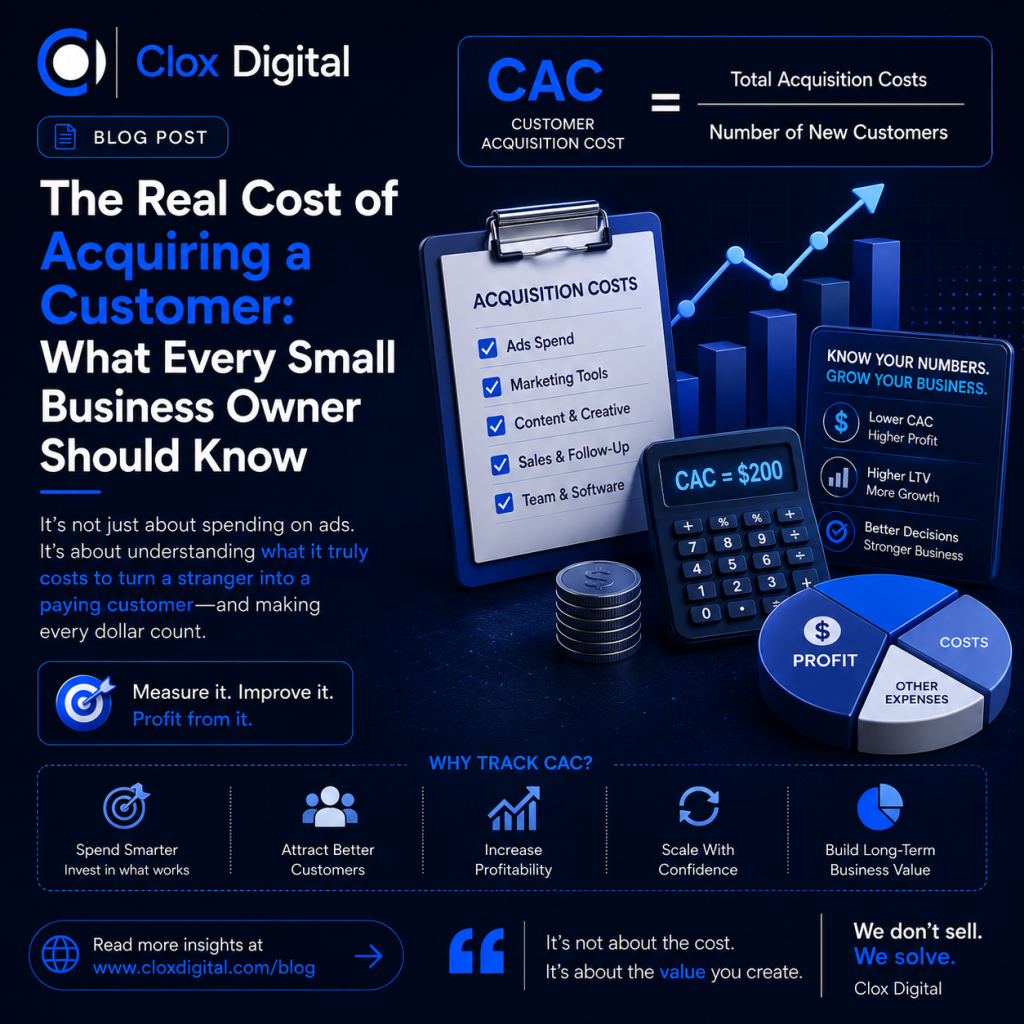
- Customer acquisition cost
- Conversion rate
- Revenue generated
- Customer lifetime value
- Return on advertising spend
The campaign with the most activity isn’t necessarily the campaign making you the most money.
9. You’re Giving Up Before the Algorithm Has Enough Information
Another common mistake is constantly changing campaigns.
Monday:
New audience.
Wednesday:
New creative.
Friday:
New budget.
Next week:
New campaign.
Then the business owner concludes:
“Nothing works.”
The problem may be that nothing was given enough time or consistency to produce useful information.
Testing requires discipline.
Change variables intentionally.
Test different:
- Hooks
- Offers
- Creatives
- Audiences
- Landing pages
- Calls to action
Then evaluate the results.
Meta’s own testing guidance emphasizes isolating variables when testing so that you can determine what actually caused a performance change. (Facebook)
Don’t randomly change everything.
Test deliberately.
10. Your Sales Process Is Losing the Leads
Here’s something many advertising discussions overlook:
The ad isn’t responsible for closing every sale.
Suppose your campaign generates 100 leads.
Only five become customers.
Before blaming the advertisement, investigate what happened to the other 95.
Did someone contact them?
How quickly?
What did the salesperson say?
Were they qualified?
Did anyone follow up?
How many times?
Was there a CRM?
Were prospects abandoned after one unanswered message?
You could have an excellent advertising campaign and a poor sales process.
And the result would still be poor revenue.
The Real Facebook Ads Funnel
Successful advertising isn’t simply:
Ad → Sale
It’s more like:
Audience
↓
Creative
↓
Click / Engagement
↓
Landing Page
↓
Offer
↓
Lead
↓
Follow-Up
↓
Sales Conversation
↓
Customer
↓
Repeat Customer
Every stage presents an opportunity for conversion—or a point of failure.
That’s why simply asking:
“Are my Facebook Ads working?”
isn’t enough.
You need to ask:
“Where in my customer acquisition journey am I losing people?”
A Simple Facebook Ads Diagnostic
Before increasing your budget, review these seven areas.
If you’re getting impressions but little engagement:
Look at your creative and messaging.
If you’re getting engagement but few clicks:
Look at your offer and CTA.
If you’re getting clicks but few leads:
Look at your landing page and offer.
If you’re getting leads but few qualified leads:
Look at your targeting and messaging.
If you’re getting qualified leads but few customers:
Look at your sales process.
If you’re getting customers but they’re unprofitable:
Look at your CAC, pricing, margins and customer lifetime value.
If results vary dramatically:
Look at your tracking, attribution, creative fatigue and testing structure.
This is much more useful than simply turning the campaign off and saying:
“Facebook doesn’t work.”
Don’t Forget Creative Fatigue
Even a strong advertisement can eventually become less effective.
People see the same creative repeatedly.
They stop noticing it.
Engagement can decline.
Costs can increase.
This is why creative testing should be an ongoing part of your advertising strategy.
Instead of relying on one advertisement for months, build a creative system around different angles.
For example:
Problem angle
“Why are your website visitors not becoming customers?”
Outcome angle
“Turn more of your website traffic into paying customers.”
Educational angle
“7 reasons your website isn’t generating leads.”
Social proof angle
“How businesses can turn digital traffic into measurable growth.”
Same underlying service.
Different customer motivations.
The Biggest Mistake: Increasing the Budget Too Soon
Suppose you’re spending $1,000 per month and your campaign isn’t profitable.
Increasing it to $3,000 doesn’t automatically fix anything.
It can simply produce three times as much inefficiency.
Fix the system before you scale the system.
First identify:
- Who converts
- Which message works
- Which creative works
- Which offer works
- Which landing page converts
- Which leads are valuable
- What your acquisition cost is
- How your sales team follows up
Then scale.
What a Good Meta Advertising Strategy Should Actually Do
A strong campaign should connect several pieces of your business.
1. Understand the customer
Know their problem, desire, objections and buying behavior.
2. Create the right message
Give them a reason to pay attention.
3. Present the right offer
Make the next step valuable and clear.
4. Send them somewhere designed to convert
Don’t waste paid traffic on a confusing customer journey.
5. Track what happens
Measure leads, customers and revenue.
6. Test
Continuously learn what works.
7. Optimize
Move resources toward what produces better results.
8. Scale
Once the economics make sense, increase investment carefully.
Facebook Ads Aren’t a Magic Button
This is perhaps the most important lesson.
You cannot solve:
A bad offer with targeting.
You cannot solve:
A poor website with more traffic.
You cannot solve:
Weak sales follow-up with better creative.
And you cannot solve:
An unprofitable business model with advertising.
Advertising amplifies your customer acquisition system.
If the system works, advertising can help you scale it.
If the system doesn’t work, advertising can simply make the problem more expensive.
Before You Spend Another Dollar, Ask These Questions
Who exactly am I trying to reach?
What problem am I solving for them?
Why should they choose my business?
Is my offer compelling?
Does my advertisement communicate the outcome clearly?
Does my landing page match the advertisement?
Can visitors easily take the next step?
Am I tracking actual conversions?
How quickly are leads being followed up?
What does it actually cost me to acquire a customer?
If you cannot answer these questions, your next step probably shouldn’t be increasing your ad budget.
It should be improving your strategy.
The Bottom Line
Facebook Ads can be an extremely effective acquisition channel for small businesses, but successful advertising isn’t about simply putting money behind a post.
It’s about building a system that connects:
The right audience → the right message → the right offer → the right experience → the right follow-up.
When those pieces work together, advertising becomes much more than a way to generate clicks.
It becomes a customer acquisition engine.
And when they don’t, throwing more money at the campaign rarely solves the underlying problem.
Before you spend more, find the leak.
Then fix it.
At Clox Digital, we believe digital marketing should be connected to measurable business outcomes—not vanity metrics.
We don’t sell. We solve.
Clox Digital — Digital Marketing, Strategy, Web Development and Growth Solutions for businesses ready to turn digital visibility into measurable growth.