

Running a small business in the United States has never been more competitive. Whether you operate a local service company, e-commerce store, professional practice, restaurant, real estate business, or consulting firm, your customers have more choices than ever before.
The question is no longer whether your business should be online. The real question is whether your digital presence is actually helping you generate sales.
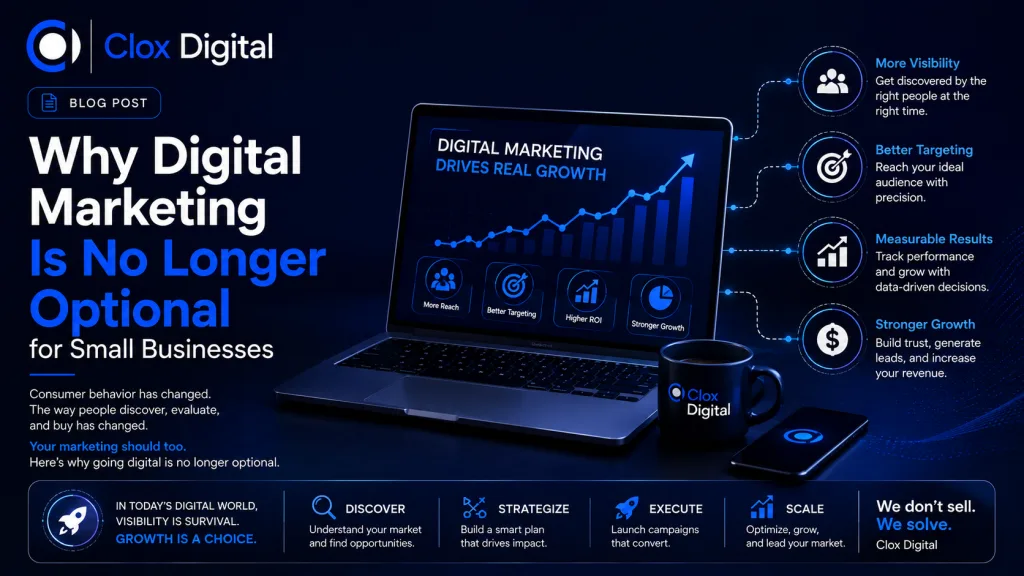
Digital marketing has become one of the most effective ways for small businesses to reach potential customers, build trust, generate leads, and turn attention into revenue. When used strategically, it gives smaller businesses the opportunity to compete with much larger companies without needing an enormous marketing budget.
Your Customers Are Already Searching Online
Before contacting a business, many consumers research online.
They may search Google for a service, look at a company’s website, check its social media pages, read reviews, compare prices, or search for recommendations. If your business cannot be easily found during this process, you may be losing customers before you even know they were interested.
For example, someone looking for a local roofing contractor may search “roof repair near me.” Someone looking for an immigration attorney may search “immigration lawyer in Texas.” A customer looking for a product may discover it through Instagram, TikTok, Google, or an online advertisement.
Your potential customers are already using digital channels to make purchasing decisions. Your business needs to be present where those decisions are happening.
Digital Marketing Turns Visibility Into Opportunities
Simply having a website or social media account does not guarantee sales.
The real value of digital marketing comes from strategically putting your business in front of people who are most likely to become customers.
A well-planned digital marketing strategy can combine:
- Search engine optimization (SEO)
- Google advertising
- Facebook and Instagram advertising
- Content marketing
- Email marketing
- Social media marketing
- Retargeting campaigns
- Landing pages
- Online reputation management
Each channel can serve a different purpose.
SEO can help people discover your business when they are actively searching. Paid advertising can put your offer in front of specific audiences. Social media can build familiarity and trust. Email marketing can bring previous customers back.
Together, these channels can create a system that consistently moves potential customers toward a purchase.
Small Businesses Can Target the Right Customers
One of the biggest advantages of digital marketing is targeting.
Traditional advertising often requires businesses to reach a broad audience and hope that some of those people are interested. Digital advertising allows businesses to be much more selective.
For example, a small business can create campaigns based on factors such as location, interests, demographics, online behavior, search intent, and previous interactions with the business.
A local dentist does not necessarily need to advertise to the entire United States. They can focus their marketing on people within a reasonable distance of their practice.
A company selling products online can target consumers based on their interests and purchasing behavior.
This ability to focus advertising on potential customers can make a limited marketing budget significantly more efficient.
Your Website Should Do More Than Look Good
A common mistake among small businesses is treating a website as an online brochure.
Your website should have a purpose beyond simply displaying your company’s information.
A sales-focused website should make it easy for visitors to understand:
- What your business offers.
- Who your service or product is for.
- Why they should choose you.
- What makes your business different.
- How they can take the next step.
That next step could be purchasing a product, booking an appointment, requesting a quote, scheduling a consultation, calling your business, or submitting a lead form.
A beautiful website that generates no inquiries is not necessarily an effective website. The goal should be to combine professional design with a clear customer journey.
Social Media Can Build Trust Before the Sale
Social media is not simply a place to post promotional content.
For small businesses, it can be one of the most powerful tools for demonstrating expertise and building credibility.
Potential customers may visit your social media profiles before deciding whether to do business with you. Educational content, customer experiences, behind-the-scenes content, product demonstrations, testimonials, and useful advice can help establish credibility.
The objective is not to constantly tell people to “buy now.”
Instead, businesses should consistently answer a more important question:
Why should this customer trust us with their money?
When customers repeatedly see useful, credible, and relevant content from a business, that business becomes more familiar. Familiarity can make the eventual purchasing decision easier.
Paid Advertising Can Accelerate Growth
Organic marketing can be extremely valuable, but it can also take time.
Paid advertising allows businesses to accelerate their reach and put their offers in front of potential customers much faster.
Platforms such as Google, Facebook, and Instagram allow businesses to create highly targeted campaigns and measure results.
However, spending money on advertising does not automatically create sales.
Successful advertising requires more than simply boosting a social media post. Businesses need the right audience, compelling messaging, an attractive offer, effective creative, a strong landing page, and a clear conversion process.
Most importantly, businesses should measure what happens after someone clicks the advertisement.
A campaign generating thousands of clicks but very few customers may not be successful. A campaign generating fewer clicks but producing highly profitable customers may be far more valuable.
Digital Marketing Makes Your Results Measurable
Another major advantage of digital marketing is the ability to track performance.
Instead of simply asking, “Did our marketing work?” a business can examine specific metrics such as:
- Website traffic
- Leads generated
- Cost per lead
- Conversion rate
- Customer acquisition cost
- Sales generated
- Return on advertising spend
- Email engagement
- Repeat purchases
This information allows business owners to make better decisions.
If one campaign is producing profitable customers while another is wasting money, the business can adjust its strategy accordingly.
Marketing should not be treated as an expense that disappears every month. It should be treated as an investment that is measured, analyzed, and optimized.
Your Competitors Are Already Marketing Online
Perhaps the most important reason to take digital marketing seriously is simple: your competitors are probably already doing it.
When a potential customer searches for a product or service and sees your competitor’s advertisement, website, reviews, and social media presence instead of yours, that competitor has an opportunity to win the customer.
Ignoring digital marketing does not mean your customers stop searching online.
It simply means someone else may be getting their attention.
For small businesses, this makes having a clear digital marketing strategy increasingly important—not necessarily to spend more than competitors, but to market more intelligently.
You Don’t Need an Unlimited Budget to Start
A common misconception is that digital marketing is only effective for businesses with large advertising budgets.
That is not true.
Small businesses can start with a manageable budget and scale their marketing as they identify what works.
The key is to avoid spreading a limited budget across too many channels without a strategy.
A business may be better served by identifying its most valuable customer, understanding where that customer spends time online, developing a compelling offer, and building a focused campaign around that audience.
Once the business begins generating measurable results, it can reinvest part of its revenue into growth.
The Goal Is Not More Followers. It Is More Business.
Likes, followers, impressions, and views can be useful indicators, but they should not become the ultimate objective.
A business does not pay its employees with followers.
It pays them with revenue.
The purpose of digital marketing should ultimately be connected to business outcomes: generating qualified leads, acquiring customers, increasing sales, improving customer retention, and building long-term brand value.
This shift in mindset is important.
Instead of asking:
“How many people saw our post?”
Ask:
“How many qualified customers did our marketing create?”
That is where digital marketing becomes a genuine business growth strategy.
Build a Digital Marketing System, Not Random Campaigns
Successful marketing is rarely the result of one advertisement or one viral social media post.
It is the result of a system.
Your business needs to attract potential customers, capture their attention, build trust, present a compelling offer, make purchasing easy, and continue communicating with customers after the sale.
When these pieces work together, digital marketing becomes more than online promotion. It becomes a customer acquisition system.
Final Thoughts
For today’s U.S. small business owner, digital marketing is no longer something that can simply be considered “nice to have.”
Your customers are online. They are searching, comparing, researching, watching, reading reviews, and making purchasing decisions through digital channels every day.
The businesses that understand this behavior and build strategies around it have an opportunity to reach customers more efficiently, compete in crowded markets, and create sustainable growth.
You do not necessarily need the biggest marketing budget.
You need a clear strategy, the right audience, compelling messaging, measurable campaigns, and the discipline to continually improve.
The businesses that market strategically today are positioning themselves for the customers of tomorrow.
