
Your next customer may not be searching Google the way they used to. They may be asking AI to find the business for them.
For years, the digital discovery process was relatively straightforward.
A potential customer would open Google, type a few keywords, scan the results, click a website, compare businesses, and make a decision.
Today, that journey is changing.
A customer might instead ask:
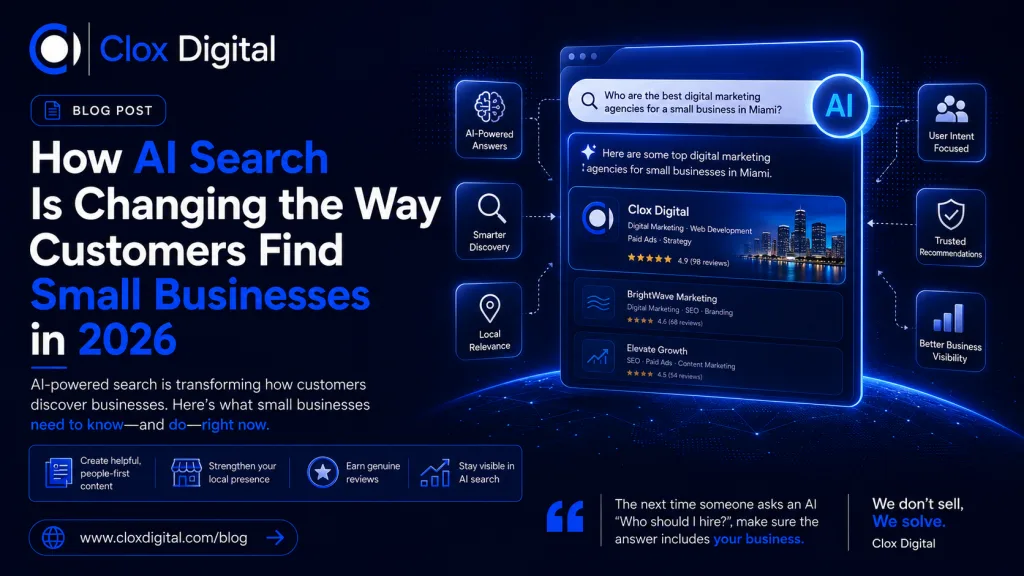
“What are the best digital marketing agencies for a small business in Miami?”
Or:
“Find me a reputable immigration attorney in Houston who works with small businesses.”
Or:
“What accounting firm should I use if I own a growing e-commerce business in California?”
Instead of receiving a traditional list of links, the customer may receive an AI-generated answer containing a small selection of businesses, explanations, comparisons, and links.
That creates a new challenge for small businesses:
How do you make sure your business is part of the answer?
Search Is No Longer Just About Blue Links
Google Search is increasingly incorporating AI into the search experience through features such as AI Overviews and AI Mode.
Google says AI Overviews now have more than 2.5 billion monthly active users, while AI Mode has surpassed 1 billion monthly users. Google has also reported that AI Mode queries have been more than doubling each quarter. (blog.google)
At the same time, customers are using standalone AI tools to research products, services, companies, and purchasing decisions.
This doesn’t mean traditional search has disappeared.
It means the definition of search is expanding.
A potential customer can now discover your business through:
- Traditional Google results
- Google Maps
- Google AI Overviews
- Google AI Mode
- ChatGPT
- Gemini
- Perplexity
- YouTube
- Social media
- Review platforms
- Industry directories
- Online communities
The customer doesn’t necessarily care which platform they use.
They care about getting a trustworthy answer.
And that changes what businesses need to optimize for.
The New Question: Can AI Understand Your Business?
Imagine a customer asks an AI system:
“Who are the best digital marketing agencies for a small business in Atlanta?”
The system needs to determine which companies are relevant.
It needs to understand:
What does each company do?
Where does it operate?
Who does it serve?
What makes it credible?
What services does it offer?
Does other information on the web support those claims?
Is there enough trustworthy information to recommend the company?
This is fundamentally different from simply placing a keyword on a webpage.
Your business needs to be understandable to machines and convincing to humans.
Traditional SEO Still Matters
This is an important distinction.
AI search does not mean you should abandon SEO.
Google explicitly says that the foundational SEO practices used for traditional Search remain relevant to AI features such as AI Overviews and AI Mode. There are no special technical requirements that guarantee inclusion; pages still need to be crawlable, indexable, and eligible for Google Search, while content should be helpful, reliable, and created for people. (Google for Developers)
Think of it this way:
Traditional SEO helps search engines find and understand your website.
Strong digital authority helps AI systems understand why your business may be worth mentioning.
You need both.
The Way People Ask Questions Is Changing
Traditional search might look like:
“digital marketing agency Miami”
AI search can be much more conversational:
“I run a small professional services company in Miami. I need an agency that can help me generate qualified leads through paid advertising. What agencies should I consider?”
That second question contains much more context.
The AI needs to evaluate multiple factors simultaneously.
This is one reason AI search can change how businesses approach content.
Instead of creating pages designed around one keyword, businesses should create useful resources that answer the real questions customers ask before purchasing.
Your Blog Can Become More Important
This is where content marketing becomes particularly valuable.
Suppose you operate an accounting firm.
Instead of only publishing:
“Accounting Services”
you could create useful content around questions such as:
- How much does a small business accountant cost?
- When should a growing business hire an accountant?
- What taxes does a small business need to prepare for?
- LLC vs. S-Corp: what should a growing business consider?
- What financial mistakes are costing small businesses money?
Now your website contains information that directly addresses customer questions.
The same principle applies to almost every industry.
A dentist could publish:
“How Much Does a Dental Implant Cost in California?”
A law firm could publish:
“What Should You Do After Receiving a Business Lawsuit?”
A roofing company could publish:
“How Much Does a Roof Replacement Cost in Texas?”
A marketing agency could publish:
“How Much Should a Small Business Spend on Digital Marketing in 2026?”
The goal isn’t to write articles simply because you need content.
The goal is to become a useful source of information around the problems your customers are trying to solve.
AI Search Rewards Specificity
One of the biggest opportunities for small businesses is becoming extremely specific about what they do.
Compare:
“We provide professional services.”
with:
“We provide bookkeeping and tax preparation services for small businesses in Dallas, Texas.”
The second statement gives both people and search systems considerably more context.
Your website should clearly communicate:
What you do
Who you serve
Where you operate
What problems you solve
What industries you specialize in
What makes your approach different
How customers can contact you
Specificity creates clarity.
And clarity makes your business easier to understand.
Your Online Reputation Matters More Than Your Website Alone
Your website isn’t the only source of information about your business.
AI systems can encounter information about your company across the wider web.
That can include:
- Business directories
- Review platforms
- Industry websites
- News publications
- Professional organizations
- Social media
- YouTube
- Podcasts
- Customer discussions
- Partner websites
- Other third-party sources
This creates an important concept:
Your business has a digital footprint.
If your website says one thing, your business directory says another, your social profiles are outdated, and your company has almost no independent mentions, you are making it harder for customers—and potentially AI systems—to establish a clear picture of your business.
Consistency matters.
Reviews Are More Than Social Proof
A five-star review isn’t just something that makes your website look good.
Reviews provide context.
Customers can describe:
What you helped them with.
Where they are located.
What experience they had.
What outcome they received.
Consider the difference between:
“Great company!”
and:
“Clox Digital helped our Texas-based business restructure our website and launch targeted advertising campaigns that generated a steady flow of qualified inquiries.”
The second review contains substantially more information about the company’s capabilities and customer experience.
That doesn’t mean businesses should manufacture reviews or manipulate platforms.
It means you should create an excellent customer experience and make it easy for genuine customers to share their experiences.
Local Businesses Have a Major Opportunity
AI search could be particularly interesting for local businesses.
Imagine someone asks:
“What’s a reliable emergency plumber near me?”
They aren’t looking for a general article about plumbing.
They’re looking for a business.
That means local businesses should make sure their digital presence clearly communicates:
Business name
Location
Service area
Services
Hours
Contact information
Reviews
Website
Relevant expertise
Your Google Business Profile, website, reviews, local directories, and other legitimate online references all contribute to your overall digital presence.
And importantly, traditional local SEO remains relevant to Google’s AI-powered search experiences. (Google for Developers)
Don’t Try to Manipulate AI Search
As AI search becomes more important, a new industry has emerged around terms such as AEO, GEO, and AI SEO.
Some of the advice circulating online suggests that businesses can use shortcuts to manipulate AI recommendations.
Be careful.
Google’s own guidance emphasizes valuable, unique, non-commodity content rather than special tricks for appearing in AI results. (Google for Developers)
And recent reporting has highlighted attempts to manipulate AI systems through artificial brand mentions and covert promotional activity on platforms such as Reddit. (The Verge)
The better long-term strategy is simple:
Become genuinely useful.
Create original information.
Build legitimate authority.
Earn real reviews.
Get mentioned for legitimate reasons.
Keep your business information accurate.
Make your expertise visible.
That creates a much stronger foundation than trying to game an algorithm.
Your Website Needs to Be Built for Humans First
There is a temptation to think:
“I need to write content for AI.”
That’s the wrong mindset.
Google’s guidance is clear: businesses should continue creating helpful, reliable, people-first content. (Google for Developers)
Your website should primarily help a potential customer make a decision.
That means your content should answer:
What does this business do?
Can they solve my problem?
Can I trust them?
How much might it cost?
What should I do next?
AI visibility becomes a byproduct of building a strong digital presence—not a replacement for it.
Think Beyond Keywords
For years, businesses were taught to think about SEO like this:
Keyword → Article → Ranking → Click
AI search requires a broader mindset:
Customer question → Useful answer → Expertise → Digital authority → Visibility → Consideration
The question is no longer simply:
“What keyword should I rank for?”
Start asking:
“What questions does my ideal customer ask before they buy?”
That’s a much more powerful content strategy.
Build Content Around the Customer Journey
A strong AI-search-ready content strategy should cover different stages of the buying journey.
Awareness
“What is digital marketing?”
Problem
“Why am I getting website traffic but no customers?”
Comparison
“Google Ads vs. Meta Ads: which is better for my business?”
Cost
“How much should a small business spend on digital marketing?”
Decision
“How do I choose a digital marketing agency?”
Action
“How can I get a marketing audit?”
Now your website isn’t just publishing random blog posts.
You’re building a knowledge ecosystem around your customer’s buying journey.
Measure More Than Website Traffic
AI search introduces another measurement challenge.
A customer might discover your company through an AI-generated answer, visit your website, and eventually become a customer without following the traditional path you are used to measuring.
Google has already begun introducing dedicated Search Console reporting for visibility from generative AI features, including AI Overviews and AI Mode, although the new reporting is initially being rolled out to a subset of websites. (Google for Developers)
That is an important development.
Businesses will increasingly need to think about:
- Search visibility
- Brand mentions
- AI citations
- Website traffic
- Qualified leads
- Conversion rates
- Customer acquisition cost
- Revenue
Visibility is useful. Revenue is the objective.
What U.S. Small Businesses Should Do Now
You don’t need to completely rebuild your digital marketing strategy overnight.
Start with the fundamentals.
1. Make your website extremely clear
Explain exactly what you do, who you serve, and where you operate.
2. Build useful content
Answer the questions your customers actually ask.
3. Strengthen your local presence
Keep your business information accurate across legitimate platforms.
4. Collect genuine customer reviews
Make customer experience and reputation a priority.
5. Demonstrate expertise
Publish case studies, insights, guides, examples, and original perspectives.
6. Build third-party credibility
Earn legitimate mentions, partnerships, industry recognition, and coverage where appropriate.
7. Keep your information consistent
Your name, services, locations, descriptions, and other important business details should not contradict each other across the web.
8. Continue investing in traditional SEO
AI search hasn’t eliminated SEO.
It has expanded the search environment in which SEO operates.
The Businesses That Win Won’t Be the Ones Chasing AI
This is perhaps the most important takeaway.
You don’t need to create content simply because:
“AI is trending.”
You need to create content because your customers have questions.
You need to build a website because customers need somewhere trustworthy to learn about your business.
You need reviews because customers want evidence.
You need SEO because customers need to find you.
You need strong branding because customers need to remember you.
And you need a strong digital reputation because customers—and increasingly AI systems—need reasons to trust you.
AI is changing the interface.
The fundamentals of good marketing haven’t disappeared.
They have become more important.
The Bottom Line
The future of digital discovery isn’t going to be limited to:
“Search → Click → Website.”
Customers are increasingly asking more complex questions and expecting technology to help them research, compare, and make decisions.
Google’s AI features are designed to provide direct answers while still connecting users to supporting websites, and Google says these experiences can create opportunities for a wider range of sites to be discovered. (Google for Developers)
For small businesses, that means your digital presence needs to do more than simply exist.
It needs to be understandable.
It needs to be useful.
It needs to be credible.
And it needs to give customers a reason to choose you.
The next time someone asks an AI:
“Who should I hire?”
you don’t want your business to be invisible.
You want your digital presence to give the answer enough reasons to include you.
The future of search isn’t just about ranking.
It’s about being recommended.
At Clox Digital, we help businesses build digital strategies designed around visibility, credibility, customer acquisition, and sustainable growth.
We don’t sell. We solve.